When it comes to a healthy lifestyle in our home or apartment, we can't ignore the incense trend. More than just a trend, what is also called frankincense has many health benefits. There is something for everyone's taste and each person has their preferences. But how do you use it and know which incense to choose from the hundreds of options available?
To accompany your incense rituals, discover our zen incense holder lamps.
The origin of incense
Originally, incense is a resin that comes from Boswellia trees, a species belonging to the Burseraceae family. In order to produce resin, the tree must reach three meters in height. In addition, it takes up to 10 years for the accumulated resin to produce superior quality. To do this, the bark is incised to remove a long, narrow piece. It is through this that the gum-resin is then collected in a receptacle provided for this purpose. After harvesting in liquid form, it takes two to three more weeks for the secretions to harden on contact with air.
Two harvest seasons
Regarding the harvest season, two techniques oppose each other: first, what is called red incense is produced by an incision in winter but will only be harvested in spring. White incense, on the other hand, benefits from an incision in summer and is harvested in autumn. White incense is considered to be of better quality and purer, because the seasons in question naturally offer greater benefits in terms of product maturity.
Where is incense harvested?

According to historical writings, the first tree from which incense originated would have come from Dhofar, a southern region that constitutes the current Sultanate of Oman, on the border between Oman and Yemen. At the time, incense was exported through the port of Salalah, the capital. Meeting with great success, other countries then began to cultivate incense trees. Thus, the main production sites that we know today are Somalia, Yemen or India. All these countries bring together the necessary conditions for the growth of Boswellia trees and this is why they still stand today as the leaders in worldwide incense production.
Legends and religious uses of incense in the world
Since the dawn of time, incense has been used by humans for various rites and protections. Its appearance also coincides with the arrival of the first humans in Mesopotamia. Today, thanks to all the studies carried out on the subject, we can state that incense has existed for at least 6,000 years.
Incense in Antiquity

Known as the greatest perfumers of Antiquity, the Egyptians would have been the first to use incense. To name it, they used the word "senetjer" which literally means "that which makes divine". They used it particularly during religious ceremonies but also in the form of balm for the preservation of mummies. This therefore proves that among the Egyptians, incense held a special place and that its use was truly sacred. This similarity is also found among the Greeks and Romans, during the same period. The divine nature of incense appears notably in the work Metamorphoses, written by Ovid, where he affirmed that the first incense tree would have grown on the tomb of Leucothoe, mistress of Helios who would have been punished by her father Orchamos.
Incense in Buddhism

Very important in the Buddhist religion, here again incense has been used since the dawn of time until today. In Vietnam, it is used for the worship of ancestors because it is believed that the smoke released establishes a link between the dead and the living. To use incense according to traditions, a certain number of steps must be followed very strictly: first, the incense sticks must be lit on an altar. Then, when it comes time to pray, the sticks are retrieved to be placed between both hands and three salutations are performed. Once the prayer is finished, they are gently placed back on the altar as a closing of the ceremony.
More generally, in Buddhism, incense has a purifying function: thoughts and emotions are purified through its use and the offering of incense allows to enter into a good relationship with immaterial beings, thus bringing luck, happiness and protection against evil.
Incense in Christianity

In Christianity, incense also holds a special place since it is one of the gifts brought to Christ by the Magi. To use it according to Christian tradition, incense must be burned in a thurible whose purpose is to swing to better diffuse the scent into the air. Thus, the smoke of incense rises to the sky and symbolizes in particular prayer and dreams that rise to God.
In conclusion, we can see that incense has been used - and continues to be used - by many peoples and in many historical periods. Its use plays a dual role: on the one hand, it was used for religious ceremonies and rites, and on the other hand, it was also used domestically as a home fragrance.
Is incense bad for your health?
The answer is double-edged: yes and no. In reality, the danger of incense is limited to its use. Thus, using incense, even daily, in a ventilated room and not exposed to pollution is not dangerous for health. On the contrary, using incense in a poorly ventilated and polluted room is not an appropriate solution. Similarly, it is strongly not recommended to inhale incense: it can damage the respiratory tract, cause headaches and even be a carcinogenic factor when used too intensively. It is therefore very important to respect the necessary conditions for using incense so that it is beneficial: experts advise burning only one stick per day, keeping a distance and ventilating the room as soon as it has finished burning.

Thus, burning two sticks at the same time would produce too much smoke and would have a harmful effect on health. The use of incense is also not recommended for people suffering from asthma and pregnant women, but it has no dangerous effect on children and the elderly. It is therefore necessary to use incense sparingly and find a fair balance so that it has positive effects!
What are the benefits of incense: why burn incense?
If they have been used for decades, it is because incenses have also proven their effectiveness. Indeed, it is proven that incense has a positive effect on concentration and relaxation. Its use is also recommended in certain cases of post-traumatic stress or depression and can serve to replace the use of anxiolytics. In addition, it also helps to soothe tensions and bring inner peace. It acts as a calming agent for the mind and has an impact on our physical, mental and emotional state by activating certain parts of our brain.

In Egypt, China, and Greece, incense has healing, anti-inflammatory, and antiseptic properties. However, it is the use in resin form, not sticks or cones, that prevails.
Thus, incense has the power to communicate messages, to convey meaning and to stimulate emotions and intellect. It is recognized as an artistic and poetic expression that enriches humanity, just like cuisine, music, or literature!
What are the best incenses and how to choose them?
To choose your incense correctly, you must first consider its form: in cone, stick, spiral or even in resin and even candle form, there are as many forms of incense as there are different scents.
For ease of use: cones and sticks
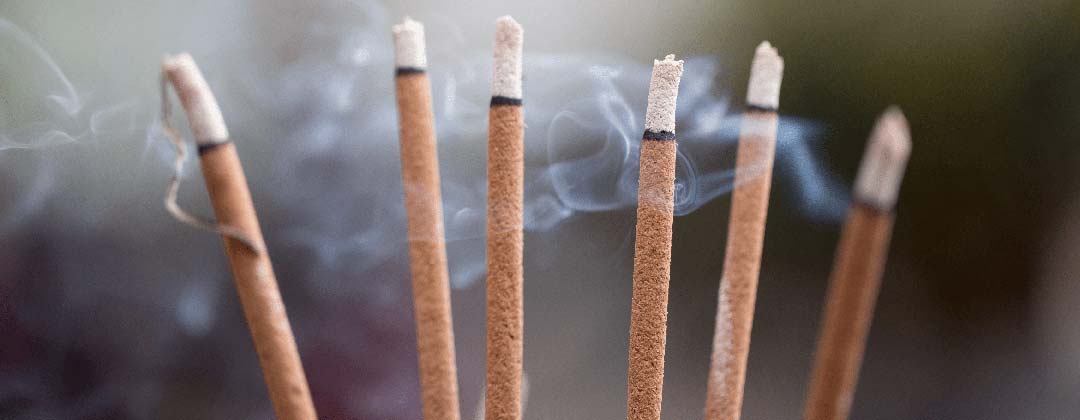
Cones and sticks are the easiest types of incense to use. All you need is an incense holder for sticks, or a censer for cones. They are easily found everywhere and for all prices. Thus, you just have to light your incense so that the ash falls on the incense holder or within the censer, guaranteeing an optimal and safe effect against fire risks.
For traditional and religious use: spirals

In China, especially, the most used incense is in spiral form. It is found particularly in temples and monasteries. To use it, you must burn the outer tip so that it burns to the center. Depending on its shape and size, spiral incense can last several hours or even several days. In some regions of the world, it is even thrown naked into the flames! However, this technique requires a certain mastery and is not recommended indoors.
For pure and natural use: resin

This is the purest form of incense as it is its original form. To use it, you need to equip yourself with resin, a specific incense burner (charcoal burner), charcoal (in tablets or directly in charcoal form), a metal spoon or tongs provided for this purpose. You then need to fill your incense burner with sand or stones to absorb some of the heat. Once the incense burner is ready for use, you add the hot charcoal, light it, and let it heat for 10 to 15 minutes. With the spoon or metal tongs, you then add the resin to the hot charcoal to release smoke. Once used, it is very important to let the charcoal cool completely before disposing of it. It is also advisable to place the incense burner beforehand on a ceramic tile or other non-flammable support to avoid burning the furniture you are using, as the very strong heat emanating from the base of the incense burner can cause damage.
For practical use: the candle

Finally, the candle is also an excellent alternative for using incense indoors. It can be found in many general and specialized stores. Several scents are available and its advantage is that it produces very little smoke, thus leaving the room perfumed and purified without creating an opaque atmosphere.
In conclusion, each incense has its advantages and its usage process. It's up to you to decide which type of incense suits you best and is most likely to meet your needs!
Little or a lot of smoke?
Depending on your wishes, it is possible to get incenses that produce a lot of smoke or, on the contrary, very little or no smoke. This is the case with Indian and Japanese incenses.
Indian Incense

Indian incense is renowned for producing a very dense and thick smoke with purifying virtues. The belief in India is that when traditional incense burns, the smoke emitted at the beginning of combustion accumulates towards the bottom of the room, thus eliminating bad energies. At the end of combustion, the smoke must rise towards the top of the room, meaning that the room is cleansed of all negative waves.
Japanese incense

Conversely, in Japanese tradition, incense produces little to no smoke. This function lies in the fact that in Japan, incense is mainly used as a home fragrance, and it is therefore more practical to use this type of incense in traditional houses and apartments to be able to continue with one's activities while the incense burns, avoiding being bothered by the smoke.
Natural incense, a real priority to consider in your choice

Now that we have discussed the different forms of incense and their burning, it is very important to remember that you should always choose natural incense rather than industrial, as the latter are very harmful to health because they are soaked in or mixed with chemical components. To differentiate good incenses from bad ones, you can apply the following tips:
- Check if the mention "100% Natural" appears on the product packaging. If this is the case, you can buy the product with confidence because this mention is protected and verified.
- Carefully check the list of components: if your product indicates the use of artificial colors, synthetic fragrances, saltpeter, charcoal or sawdust, we advise you not to buy it. The presence of these ingredients leads to the diffusion of benzene during combustion, which is very harmful to health.
- Prefer slightly more expensive incenses to the cheapest ones: the last piece of advice we can give you is to pay attention to the price of your incense. Incense that is too cheap is often a guarantee of poor composition. It is therefore preferable to spend a few more euros to get a durable and quality incense without negative effects on health!
What incense scents for what effects?

If you are looking for a particular type of incense according to your needs, here are our recommendations:
-
For well-being: lily of the valley and lotus
-
For indoor purification: sage, frankincense, myrrh cones, rosewood
-
For energy and optimism: cinnamon, vanilla, clove
-
For creativity: star anise
-
For concentration: cypress
-
For sensuality: musk, narcissus
-
For serenity: white sandalwood, lavender, pine
-
For sleep: sandalwood, cinnamon, agarwood
-
For meditation: frankincense, cedar, sandalwood, floral scents
-
For love: white plum
-
For receiving guests: cherry blossoms
-
For harmony and balance: spicy sandalwood
-
For relaxation: blue iris
There are also many other fragrances, each with a well-defined role. To find out which incense is right for you, you can base your decision on your fragrance preferences: floral, woody, spicy, sweet... You are sure to find the one that suits you among this wide selection. Moreover, since incense is generally very fragrant, don't hesitate to stimulate your senses when you go to a store and smell the different fragrances available through the packaging!
Can frankincense essential oil be used and for what effects?

Yes, it is entirely possible to use incense or frankincense in the form of an essential oil. It is generally consumed topically, but it is essential to strictly follow the indicated dosage for each product, as it differs from one brand to another.
The benefits of frankincense in essential oil form are numerous: it would first alleviate joint and respiratory pain and inflammation thanks to its immunomodulatory function. It also has a positive effect on wound healing. Furthermore, frankincense essential oil is also used to treat various respiratory disorders such as rhinitis, bronchitis, or asthma. Finally, it can also be used to help promote sleep by offering a significant improvement in sleep quality.
How to use white sage as incense?
White sage is a sacred plant traditionally used by Native American peoples of North America. It is particularly found in religious ceremonies, as well as to honor a birth or a death. A true ancestral ritual, it is believed to have the power to dispel negative vibes to create positive energy in the room.
There are two forms of white sage: either in sticks or directly as leaves to burn. To use it traditionally, you can purchase leaves in specialized stores. Then, simply place the leaves in a heat-resistant bowl, with an abalone shell bowl being recommended for this incense. Light the leaves with a match or a lighter, wait a few seconds, then blow out the flame. The fumigation will naturally occur: when the smoke begins to escape, pick up your bowl (be careful not to burn yourself, hence the importance of choosing a heat-resistant receptacle so you can carry it!) and go from room to room in your home to let the smoke spread.

As you pass through the rooms, the windows must be open for two reasons: first, it allows excess smoke to escape and prevents any risk. Second, the evacuated smoke contains the bad energies of the dwelling and must therefore be released outside to purify the interior.
We hope you enjoyed this article about incense, its origins, and its use. Feel free to leave a comment to tell us what place incense has in your life, what your favorite scents are, and what recommendations you would give to those who wish to start using incense!


